
·Research
Finite Basis PINNs
Domain-decomposed physics-informed networks for multi-scale ODEs. Many small subdomain networks add to one global solution that an ordinary PINN can't reach.
DLSC Project B, with Guglielmo Pacifico — a study and partial reproduction of Finite Basis Physics-Informed Neural Networks (FBPINNs): a scalable domain decomposition approach for solving differential equations.
The problem
Standard PINNs struggle with high-frequency and multi-scale problems — a manifestation of the spectral bias of neural networks. As the target contains more frequencies, the network has to grow rapidly, and the optimisation landscape gets correspondingly worse.
What FBPINNs do
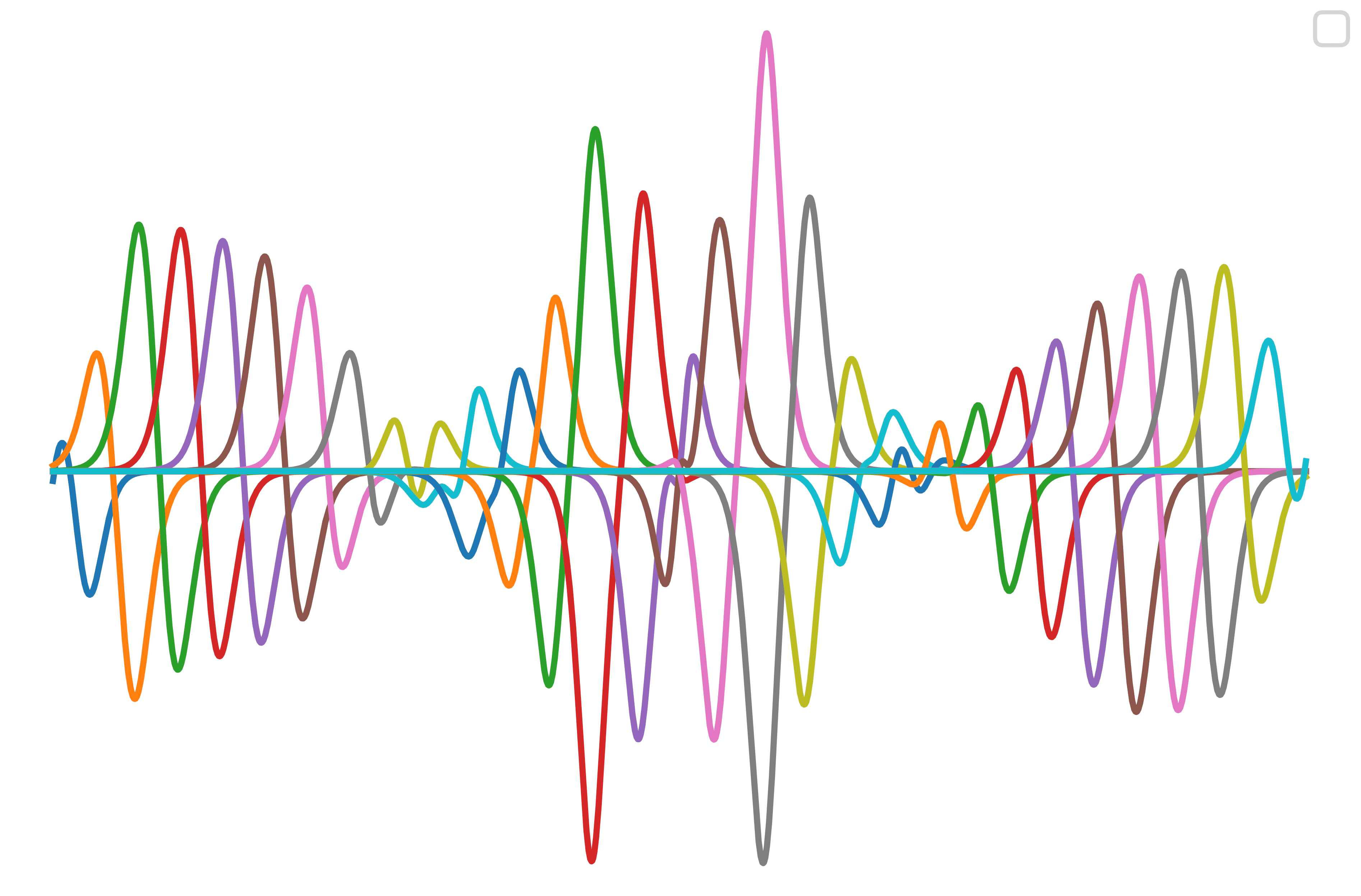
The domain is split into partially overlapping subdomains. Each subdomain gets its own small network , and the global solution is a sum of windowed local solutions:
where is a smooth window built from sigmoid factors, and rescales each subdomain to . The boundary condition is baked into an ansatz so the loss can collapse to the physics term alone:
Experiments
We reproduced the headline experiments from the paper:
- Single-frequency case — for and . PINNs match FBPINNs at low frequency; at the PINN underfits while the FBPINN tracks the analytical .
- Multi-scale case — with . Five subdomain networks of neurons recover the full solution; the equivalent PINN needs to get close.
- Scalability — varied the number of frequency components and tracked -loss vs training time. PINN training time grows roughly linearly with depth; FBPINN time grows weakly with subdomain count once you parallelise.
The image on the card is the per-subdomain output — overlapping localised wave packets that sum to a smooth global solution.
Takeaways
- For mildly multi-scale problems () a deep PINN gets there — the FBPINN's win is mostly time, not accuracy.
- For genuinely multi-scale problems the subdomain decomposition seems to break the spectral bias by giving each network a band-limited target.
- The window function setup matters more than expected. We saw qualitatively different individual-network solutions vs the paper, even with consistent global behaviour, suggesting the decomposition is somewhat under-determined.